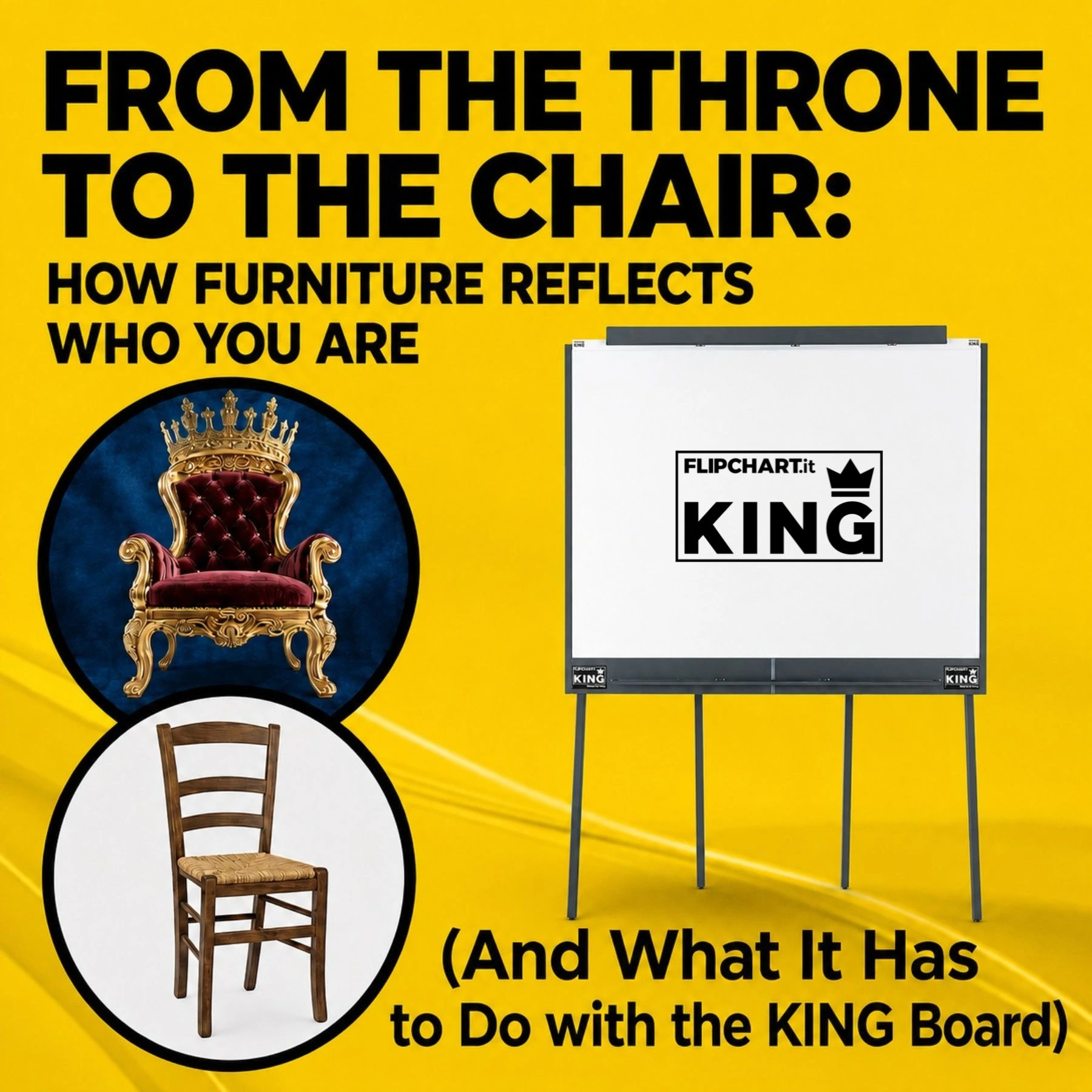
“All inventions in furniture design are driven by humanity reaching a new level of self-awareness.”
This premise might sound complex, but I want to share an eye-opening insight I discovered while reading Jeremy Rifkin’s masterwork, “The Empathic Civilization.”
This book is a phenomenal historical analysis of social evolution, from ancient Babylonian societies to the modern era.
Among its many themes, it touches upon an unexpected topic: how furniture design directly mirrors the evolution of human self-perception.
Up until the Middle Ages, humans did not possess a concept of individuality as we know it today.
People were strictly defined by their collective group: their family, their guild, or their trade.
They perceived themselves merely as “one among many.”
The dynamics, rules, and expectations of the collective were the only metrics that mattered.
For those of us living in a modern society driven by ambition, personal branding, and individual success, this mindset is almost impossible to grasp.
In medieval times, privacy was virtually non-existent.
People slept and ate communally, even within royal palaces.
They sat on long benches pushed against walls, on three-legged stools, or on cushions on the floor.
The only individual chair in a medieval palace was the throne—reserved exclusively for the monarch to signal absolute superior status.
The Individual Chair Revolution and the Birth of the Self
It was only with the advent of the Renaissance and Humanism that individuals unlocked the conscious awareness of the self as an autonomous entity.
This breakthrough in personal autonomy was immediately reflected in the physical objects surrounding them.
Did you know that the individual chair, as a common object for personal use, was introduced only around the year 1490 at the Palazzo Strozzi in Florence, Italy?
The concept of the chair was a massive cultural disruption: it physically manifested the reality that every human being is an independent, complete entity.
In France, it instantly became an obsession: every member of the rising bourgeois class demanded one to elevate their social status. Essentially, anyone who could afford it bought their own personal throne.
But how does this piece of history connect to a widescreen presentation board and professional visual communication?
Let’s bridge the gap.
The Unspoken Need: It’s Not Just a Board, It’s an Identity
A few months ago, during a coffee break at a corporate seminar, my business partner Tiziana and I met a young professional who approached us to praise the KING Flipchart project.
During our conversation, she said:
“In a few months, my first official training program will be ready, and I cannot wait to launch it so I can finally allow myself to use a KING!”
Intrigued by her choice of words, I asked: “…Allow yourself? What do you mean? Financial or physical space?”
She replied: “No, I mean that KING will dramatically improve how I deliver my message, but I need to feel ready for it internally.”
We pay meticulous attention to the deep emotional drivers of the professionals who want our giant boards.
Some want it for emulation, some purely for the high-end aesthetic, and others simply because they need the massive landscape paper surface to map out concepts.
But this speaker was tapping into a much deeper, psychological current.
KING was evoking a need she struggled to articulate.
Conversing with her, it hit us: at that exact moment, she hadn’t yet internally claimed her status as an “Expert.”
Consequently, she didn’t feel “worthy” yet of standing on stage next to a KING.
Only after launching her flagship course, in her mind, would she officially validate that professional milestone by showcasing herself alongside the panoramic board.

KING Flipchart: The Ultimate Benchmark of Authority
This revelation deeply impacted us.
We are often the first to be amazed by the psychological and emotional transformations our product triggers in public speakers and corporate trainers.
Just as the individual chair in 1490 redefined identity and status for the elite, today the grand KING Flipchart represents the visual status of the EXPERT.
It is the definitive stage emblem that distinguishes speakers who have chosen to play at the highest level of professional visual communication.
It is not a tool designed for those who are afraid to stand out; it is the standard, the statement, and the operational powerhouse for those who recognize their own value and want their audience to perceive it instantly, without hesitation.
If you are ready to claim your professional status and maximize your authority on stage or in front of the camera, explore the elite engineering that makes this tool unmatched.
Select your KING Flipchart model
and command the room
Are you ready to step up to your personal throne on stage?
To your great success!
Sandro Rizzo
Co-founder & Inventor of KING Flipchart